
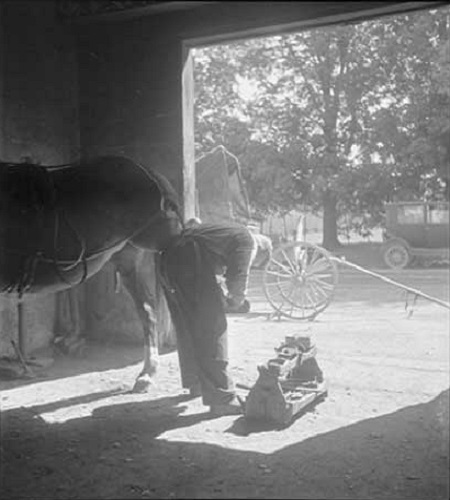
[Two male blacksmiths hammering on an anvil in a blacksmith shop.]
[NARRATOR:] Blacksmithing was once a staple and lucrative trade.
[Blacksmith hammering a rusty chain on an anvil.]
[NARRATOR:] But after the rise of industrialization during the second half of the 19th century, blacksmiths found ways to adapt to the needs of their changing communities.
[An artist blacksmith student using a welding tool on a sheet of metal. Sparks fly as he does this.]
[A blacksmith uses a pair of metal tongs to twist and attach a chain onto a chain link over a coal forge.]
[NARRATOR:] One of the most significant changes to the trade included the introduction of mass production factories and new technologies.
[A black and white photo of three blacksmiths posing inside of a blacksmith shop.]
[A black and white photo of men working in an assembly line at a factory.]
[NARRATOR:] This brought about momentous change in the work environments as well as the trade techniques the blacksmiths were so used to working with.
[A black and white photo of two blacksmiths standing beside an anvil inside a blacksmith shop.]
[Blacksmith turning the crank on the bellows in a blacksmith shop.]
[A coal forge is seen burning inside of a blacksmith shop.]
[A black and white photo of six blacksmiths posing inside of a blacksmith shop. Several blacksmithing equipment and tools surround them, as well as a horse can be seen on the right hand side of the photo.]
[A black and white photo of a male blacksmith standing in front of a blacksmith shop. Behind him is a clothes line with socks, stockings, and a shirt hung up with clips.]
[NARRATOR:] Although some blacksmiths accepted these changes others believed that their business would survive without ever needing to change.
[A blacksmith shows off a blacksmithing tool found inside his blacksmith shop to the camera.]
[Various shots of blacksmithing equipment and tools inside a dimly lit blacksmith shop.]
[NARRATOR:] Blacksmiths living in urban communities were specifically accepting of the impact industrialization brought about to society. In most cases, urban blacksmiths had no choice but to succumb to these advancements. Most if not all mass production factories were located in more modernized communities.
[A blacksmith shows off a piece of metal to the camera. The piece of metal has a hole on one end, and a tapered end on the other. He is also holding a small piece of flat wood on his right hand, showing the audience where the piece of metal could attach to it.]
[Blacksmith is hammering a small, thing piece of metal over an anvil, and then dips he metal into a bucket of water. The piece of metal begins to sizzle upon contact with the water.]
[NARRATOR:] On one hand this brought about the need to hire hundreds and thousands of employees greatly impacting the job market during this period.
[NARRATOR:] On the other hand, this meant that traditional blacksmiths were no longer necessary in society.
[A shot of the exterior of a blacksmith shop during the daytime. The blacksmith shop is seen on the left side, while a metal carriage wheel is on the right, leaning against a tall tree.]
[NARRATOR:] Only a few traditional blacksmiths in urban communities refused to work in these factories.
[A black and white photo of a blacksmith seen holding a hammer and standing beside an anvil. He is standing in the middle of a blacksmith shop, surrounded by various blacksmithing tools and equipment.]
[NARRATOR:] They would soon then realize that their labor was not needed that much anymore; therefore, negatively affecting their business.
[A close-up shot of an anvil inside of a blacksmith shop. A coal forge can be seen in the background, as well as the bellows located on the left side of the forge.]
[NARRATOR:] Blacksmiths were still indispensable.
[A shot of the interior of a blacksmith shop. Tools and equipment can be seen hanging along the wall, as well as on the floor. An anvil and a bucket full of water is seen in the middle of the shop. The coal forge is on the right hand side, with the blower seen right in front of it.]
[NARRATOR:] They were still very much needed for repair work and custom orders for small items.
[Blacksmith is hammering a heated metal rod over an anvil.]
[NARRATOR:] They still had a large clientele depending on where they lived because how often farm tools and equipment or other items might have broken.
[A blacksmith is sawing a small, thin rod of metal into two pieces.]
[NARRATOR:] Rural blacksmiths adapted like many other trades people and shifted to repair work. This was happening well into the 1900s in the rural areas of Ontario.
[A shot of the interior and exterior of a wooden wagon. The wagon is found outside of the blacksmith shop.]
[A shot of a rusted metal wagon wheel leaning against a tree truck outside of the blacksmith shop.]
[NARRATOR:] Fanshawe Pioneer Village is a time capsule that tells the story of the rural communities in and around southern Ontario from 1820 to the 1920s.
[A shot of various traditional farm equipment located around the blacksmith shop.]
[Exterior shots of Fanshawe Pioneer Village’s blacksmith shop. There is a large sign above the entrance door that say William H. Weir Fanshawe.]
[NARRATOR:] The blacksmith shop at Fanshawe Pioneer Village is a replica building that represents an 1860s blacksmith shop.
[Horseshoes and blacksmithing tools displayed on a wooden table.]
[NARRATOR:] Today the replica shop is well equipped with two leg vices, a small and large roller used for anything from barrel hoops to tires for wagons, drill press, a shear a large anvil, (London style almost 300 pounds), a smaller anvil, various tongs and hammers, a brick forge built in compartment for coal beside it, bellows, and an upsetting machine.
[Blacksmith working on a flat metal rod, inserted in a leg vice inside the blacksmith shop.]
[A shot of a drill press functioning.]
[A shot of a London Style anvil with a chain around the base.]
[A close up shot of the wood burning in the blacksmith shop’s forge.]
[A female blacksmith hand cranks the blower, allowing air to enter the coal forge.]
[NARRATOR:] It's important to note that Fanshawe Pioneer Village uses wood in its forge rather than coal because of coal’s health dangers, and the bellows are not functional instead a blower is used. In rural areas, bellows were still more common in shops during this era.
[A male blacksmith hand cranks the blower, allowing air to enter the coal forge.]
[NARRATOR:] It wasn't until the late 1800s that blowers became commonplace in blacksmith shops even though they were easily available. A blower was important because the blacksmith could now work independently without the help of someone working the bellows.
[Inside the blacksmith shop, a female blacksmith faces the camera as she speaks.]
[FEMALE BLACKSMITH’S APPRENTICE:] So, I am what you would refer to as a blacksmith's apprentice and what that means is that I am a student of blacksmithing. Now that might sound simple, but it's actually a pretty arduous process. So, a blacksmith apprentice would start when they were pretty young and they would actually be an apprentice or a student for about seven years. Now those seven years wouldn't have been spent in school, those seven years would have been spent living with and working with their master blacksmith in order to learn every single facet of the trade. Every single facet of the way of blacksmithing life. So, after that seven-year apprenticeship, a blacksmith would then become an actual blacksmith as opposed to an apprentice and they could then work in another shop or they could do another apprenticeship for seven years so that they could then become a master blacksmith and have an apprentice of their very own.
[A shot of a broken wooden wagon tongue outside of the blacksmith shop. The male blacksmith is seen standing beside the broken wagon tongue.]
[NARRATOR:] The blacksmith has been presented with a broken wagon tongue. If you were a blacksmith facing this challenge, what would you if you had to repair a wagon tongue?